AI customer service agent pricing at 10k chats
AI customer service agent pricing at 10,000 chats a month: Fin, Zendesk and Agentforce meters vs $516 of tokens, and which handovers each one bills.
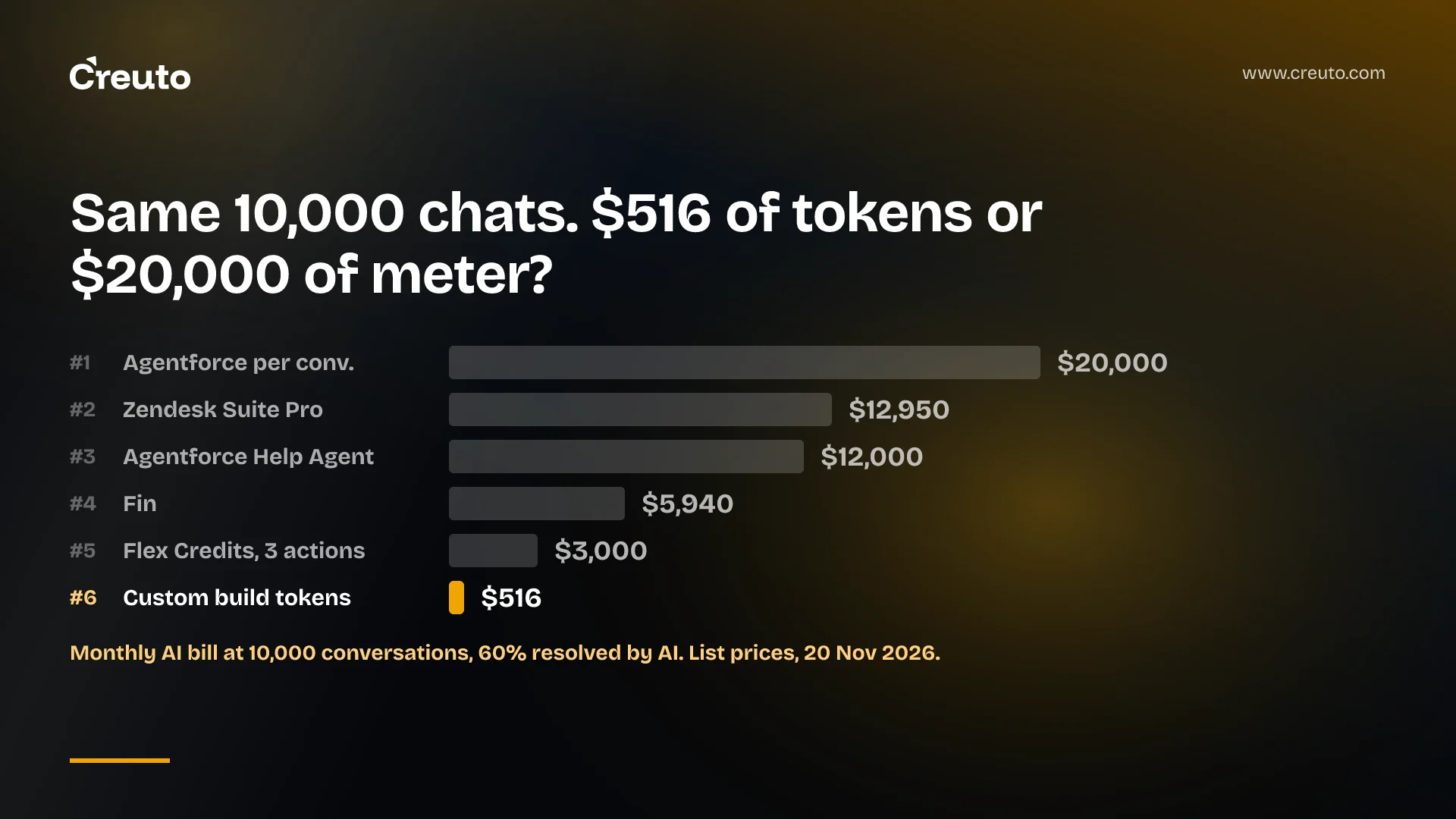
AI customer service agent pricing at 10,000 conversations a month runs from about $5,940 for Fin to $20,000 for Agentforce billed per conversation, while the raw model tokens for a custom build come to about $516. None of those lines decides the choice. The 4,000 conversations your AI hands to a human cost more than all of them.
By the end of this post you will have every vendor meter priced at one volume, from the vendors' own pages as listed on 20 November 2026. You will also know which handovers each vendor bills and what a build costs once you count the work, not just the tokens.
One company now sells three support meters
Salesforce completed its acquisition of Fin, formerly Intercom, on 10 September 2026. Its Customer Service AI pricing page now lists Fin at $0.99 per resolution, "minimum commitment applies". Its Agentforce pricing page lists Agentforce Help Agent resolutions at $2, Agentforce at $2 per conversation, and Flex Credits at $500 per 100,000 credits, with each Agentforce action costing 20 credits. That is a resolution meter at two prices, a conversation meter and an action meter, all from one vendor.
Zendesk changed its meter too. On 18 May 2026 it introduced automated resolution tiers, and only one of the three tiers is charged. The rules about what counts as a resolution, and what happens when the AI gives up, now differ across all four products.
AI customer service agent pricing at 10,000 conversations a month
Our worked example uses one support operation for every option. It handles 10,000 conversations a month, the AI resolves 60% of them (6,000), and 40% (4,000) go to a human. Ten human agents staff the queue. Every price below is the vendor's US-dollar list price as shown on 20 November 2026. None of the vendor pricing pages carries an effective date, so treat them as a snapshot.
| Option | What is billed | Monthly AI bill at our volume |
|---|---|---|
| Agentforce, per conversation | 10,000 conversations x $2 | $20,000 |
| Zendesk Suite Professional | 5,900 verified resolutions x US$2.00, plus 10 seats x $115 | $12,950 |
| Agentforce Help Agent | 6,000 resolutions x $2 | $12,000 |
| Fin | 6,000 resolutions x $0.99, plus any procedure handoffs | $5,940 and up |
| Agentforce Flex Credits | 10,000 conversations x 3 actions x 20 credits | $3,000 |
| Custom build, model tokens only | Claude Sonnet 5.5 or gpt-6.2-sol | $516 |
The table is our arithmetic on list prices, and each row rests on an assumption the sections below state. The Agentforce rows assume every conversation the AI touches is billed once. The Flex Credits row assumes three actions per conversation, which you should replace with your own count. The Zendesk row assumes all 6,000 AI-handled conversations pass verification, so it is the ceiling.
What counts as a resolution in Fin pricing
Fin bills $0.99 per outcome, and its definition of an outcome is broader than "resolved". Intercom's outcomes article, dated 23 September 2026, counts a resolution when the customer confirms the answer helped, or "exits the conversation without requesting further assistance (assumed resolution)". A customer who gives up and closes the tab is billed as a success.
The same article bills a second outcome type at $0.99: a procedure handoff, where Fin "successfully executes a Procedure that you've configured to end in a handoff to a human or a workflow." Default escalations are not billed, and when a customer explicitly asks for a human, that "does not count as an outcome and you are not billed for it". Fin charges at most once per conversation.
This is the handover line to watch. If you design 1,000 of your 4,000 handovers as Fin procedures that collect details and route the ticket, that adds $990 a month on our assumptions. Salesforce's Fin footnote says an outcome never counts when "the customer asks for a human", but it does not mention procedure handoffs at all, so read Intercom's article before you sign. Fin's own pricing page adds a $49 monthly minimum that includes 50 outcomes when you run Fin on an existing helpdesk such as Zendesk or Salesforce.
Zendesk AI agent cost per resolution, and a currency the page cannot decide on
Zendesk charges only for verified resolutions. Under the tier rules, an LLM reviews each finished conversation to judge whether the request was resolved. Conversations that fail that check are "Contained resolutions" and are free. Assisted escalations, where the AI hands over to a human, are also free.
Does Zendesk charge for AI conversations escalated to a human?
No. An assisted escalation "does not count against your resolution allowance", according to the tier article. Of the three vendors, Zendesk has the cleanest handover rule: you pay only when an LLM agrees the customer was helped.
The price is less clean. The Zendesk pricing page lists Suite Professional at US$115 per agent a month, billed yearly, with 10 automated resolutions per agent a month included. Extra resolutions cost US$2.00 pay-as-you-go. In the same table, the committed rate is shown as £1.30, in pounds, next to dollar prices. We have not converted it, and the page gives no US-dollar committed rate, so ask Zendesk for the committed rate in your billing currency in writing.
For our example, 10 agents bring 100 included resolutions, leaving 5,900 at US$2.00, or $11,800, plus $1,150 in seats. In practice, some conversations will fail verification and be free, so your real bill will fall below that ceiling.
Agentforce pricing per conversation, per resolution and per action
Salesforce gives you three ways to pay for one agent. Agentforce Help Agent was announced on 25 June 2026 with pay-per-resolution pricing in July '26. It charges only when the agent resolves an issue "autonomously, start to finish", and escalations to a human generate no charge. At $2 per resolution, 6,000 resolutions cost $12,000, about twice Fin's rate on Salesforce's own pages.
The per-conversation meter is the most expensive at our volume because it bills handovers too. At $2 per conversation, the 4,000 conversations the AI fails on cost $8,000 of the $20,000. The Agentforce pricing page does not define where one conversation ends and the next begins. That matters if a customer returns to the same thread the next day.
Agentforce Flex Credits cost per action
Flex Credits cost $500 per 100,000 credits, and an Agentforce action uses 20 credits, so each action costs $0.10. Three actions per conversation (look up an order, check a policy, update a case) means $0.30 a conversation, or $3,000 at our volume. This is the cheapest vendor meter in the table, but the bill tracks how much your agent does, not whether it worked. An agent that loops through six actions before handing over costs twice as much and resolves nothing.
How many tokens a customer support conversation uses
The custom-build row is the model bill alone, and the assumptions decide it. We assume six turns per conversation. Each turn sends 8,000 input tokens (system prompt, retrieved help-center passages and the conversation so far), of which 6,000 are a cached prefix. Each reply is 400 output tokens. Prices are from Anthropic's Claude pricing page and OpenAI's API pricing page, read on 20 November 2026.
| Model | Input / cache hit / output per million tokens | Per conversation | Per month at 10,000 |
|---|---|---|---|
| Claude Sonnet 5.5 | $2 / $0.10 / $10 | $0.0516 | $516 |
| gpt-6.2-sol | $2.00 / $0.10 / $10.00 | $0.0516 | $516 |
| Claude Haiku 5.5 (prompts up to 100,000 tokens) | $0.10 / $0.01 / $0.50 | $0.0028 | $27.60 |
| gpt-6-luna | $0.10 / $0.01 / $0.50 | $0.0028 | $27.60 |
We left cache-write premiums out. Writing the cached prefix costs more than a normal input token, $2.50 per million on Sonnet 5.5 for a five-minute cache against $2 base input. That is a small addition at this shape, but it is not zero, and a prefix that changes often erases the cache-hit discount entirely. Why caching makes the input line this small is covered in prompt caching, the cheapest LLM cost cut most apps miss.
Note what is missing from the token row: the retrieval index over your help center, hosting, logging, evaluation runs and the engineers who build and maintain it. Those lines are covered in RAG implementation cost, line by line. A token bill of $516 does not mean a $516 support agent.
The handover line is bigger than every vendor meter
The 4,000 conversations that reach a human cost the same under every option, and they are the largest number in the budget. The US Bureau of Labor Statistics puts the median pay for customer service representatives at $44,770 a year (May 2025). Ten agents at that median cost about $37,300 a month in wages alone, before benefits, management and tools. That is nearly twice the most expensive AI meter in our table.
Two conclusions follow. First, if staffing scales with volume, each human-handled conversation costs about $9.33 in wages ($37,300 across 4,000). A ten-point rise in the AI's resolution rate then saves about $9,300 a month in wages, before the extra AI fees, which is more than the $6,060 gap between Fin and Help Agent. Second, how the handover works matters more than its price. A human who receives a ticket with the order, the steps the bot already tried and the customer's history closes it faster than one who starts from "hello".
That receiving side is the part we have built. Our Sales CRM build includes an After-Sales module with complaint management and ticketing, where every complaint is assigned an owner with an SLA and repeat complaints from the same customer are surfaced automatically. We have not shipped an AI support agent. But the ticket, owner and SLA structure is where any AI handover lands, and it is built the same way whichever bot sits in front of it.
Is it cheaper to build or buy an AI customer service agent?
The strongest case for buying is that the vendor meter already includes the hard parts. Fin and Zendesk ship the retrieval, the escalation logic, the evaluation and the helpdesk integration. Zendesk even runs an LLM check on every resolution so you are not billed for false ones. A custom build has to reproduce all of that, and the $516 token bill hides an engineering team.
That case holds for most teams on a standard helpdesk. Buying is the right choice when your support content lives in one help center, your volume is a few thousand conversations a month, and the AI mostly answers questions rather than takes actions in your own systems.
Building starts to pay when three things are true together:
- Volume is high enough that the meter compounds. At 10,000 conversations, the gap between Fin and the token bill is about $5,400 a month, which pays for ongoing engineering time. At 1,000 conversations it does not.
- The agent must act in systems the vendor cannot reach. Refunds in your own billing service, changes in an in-house order system or a custom CRM all need integration work either way, and that work is yours whichever bot you buy.
- The handover is the product. If routing to the right specialist, with the right context, is where your support quality comes from, owning that logic beats renting it.
Building is the wrong choice if you cannot staff the evaluation work. A support agent without a test set of real conversations, scored before every prompt or model change, will get worse quietly. That is the line item build-vs-buy spreadsheets leave out.
Pricing an AI support agent against your own handover rate
Before you compare quotes, get four numbers from your own helpdesk: monthly conversation volume, the share a bot could plausibly resolve, the share that must reach a human, and the systems the bot would need to act in. Then ask each vendor two questions in writing: which handovers it bills, and what its committed rate is in your currency.
If you are weighing a vendor meter against a build on an LLM API, our AI engineering team can model both against your real conversation logs, including the handover path into your helpdesk or CRM. A focused MVP typically takes 6-10 weeks, and the model above is the first thing we would rerun with your numbers.
Frequently asked questions
An AI customer service agent at 10,000 conversations a month costs about $5,940 on Fin, $12,000 on Agentforce Help Agent, up to $12,950 on Zendesk Suite Professional with ten seats, and $20,000 on Agentforce per conversation, at November 2026 list prices with 60% of conversations resolved by AI.
Fin bills $0.99 when a customer confirms an answer helped or leaves without asking for more help, which Intercom calls an assumed resolution. A configured Procedure that ends in a handoff to a human is also billed at $0.99. Default escalations and customers asking for a human are not billed.
Zendesk does not charge for assisted escalations, where its AI agent hands a conversation to a human. Since 18 May 2026, Zendesk bills only verified resolutions, which an LLM checks after the conversation ends. Contained resolutions that fail that check are also free.
A customer support conversation of six turns, each sending 8,000 input tokens with 6,000 cached and returning 400 output tokens, uses about 50,400 tokens. On Claude Sonnet 5.5 or gpt-6.2-sol that costs about $0.05, and on Claude Haiku 5.5 or gpt-6-luna about $0.003, excluding cache-write premiums.
Building an AI customer service agent is cheaper on model tokens, about $516 a month at 10,000 conversations, but that excludes retrieval, hosting, evaluation and engineering. Buying is usually cheaper below a few thousand conversations a month. Building pays when volume is high and the agent must act in your own systems.