AI assistant for your company: seat or build?
An AI assistant for your company: $30 Copilot seats vs about 2 cents a question on an API. Where the break-even sits, priced from vendor pages, Nov 2026.
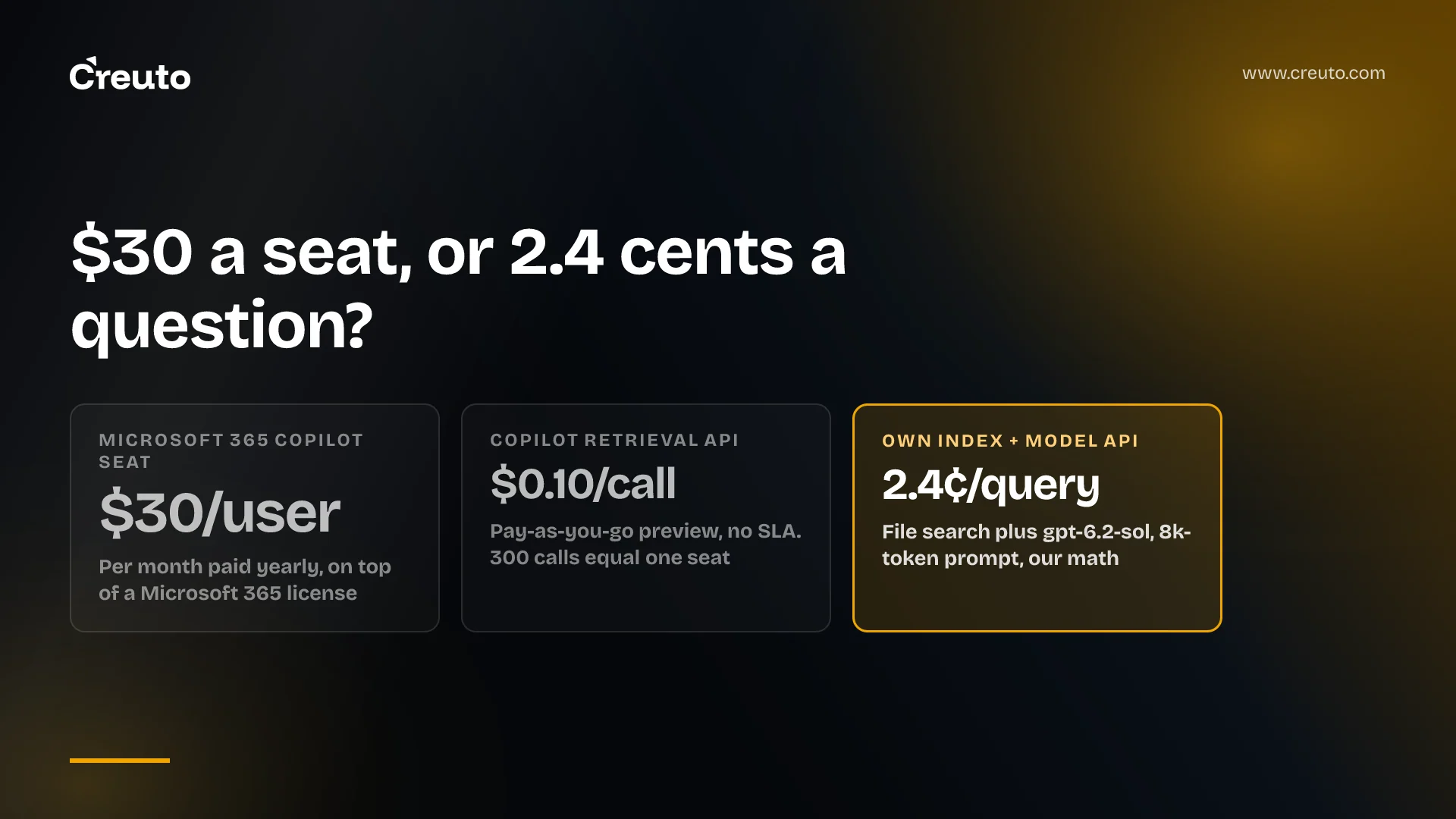
An AI assistant for your company costs either $30 per user per month as a Microsoft 365 Copilot seat, or roughly two cents a question if you build it on a model API. The break-even is a number you can measure before you buy: questions per user per month.
Every price below comes from the vendors' own pages, as of November 2026, and the figure that frames the decision is Microsoft's. Its Retrieval API, which lets you build your own assistant over SharePoint without building a search index, costs $0.10 per API call for users who have no Copilot license. Three hundred calls a month is one $30 seat. By the end of this post you will know which side of that line your staff sit on, and which build costs the per-call price leaves out.
What an AI assistant for your company costs, from the price pages
There are three ways to put an internal AI assistant in front of staff: buy a seat in the suite they already use, pay per call for Microsoft's retrieval layer under your own app, or build the whole assistant on a model API with your own document index. Here is what each one publishes.
| Route | Published price | What you get | The catch |
|---|---|---|---|
| Microsoft 365 Copilot | $30.00 per user per month paid yearly, or $31.50 paid monthly on an annual commitment | Copilot in the Microsoft 365 apps, grounded in your tenant's data | Needs a separate qualifying Microsoft 365 license |
| Copilot Business | $21 per user per month | The same Copilot capabilities, sold to smaller tenants | Up to 300 licensed users per tenant, annual commitment |
| Copilot Chat agents, pay-as-you-go | $0.01 per Copilot Studio message | Agents in Copilot Chat and SharePoint agents | Billed to an Azure subscription |
| Retrieval API, pay-as-you-go | $0.10 per API call | Permission-trimmed text chunks from SharePoint and Copilot connectors, for your own app | Preview with no SLA; OneDrive not included |
| Google Workspace Business Standard | $14 per user per month (US list price) | Gemini in Gmail, Docs, Meet and more, inside the suite price | Starter, Standard and Plus are capped at 300 users |
| Your own build on a model API | About $0.021 per question on Claude Sonnet 5.5 (our arithmetic, below) | An assistant over any data source, on the model you choose | You build, secure and run it |
Two details in that table change real budgets. First, Microsoft's Tech Community post from 17 March 2026 says Copilot Business remains $21 per user, per month while the bundles around it moved on 1 July 2026: Business Standard plus Copilot Business went from $33.50 to $35. Second, Copilot Business stops at 300 users, and Microsoft Learn tells larger organizations to use the enterprise licensing options. A company that grows from 280 to 320 people moves from $21 to $30 a seat, a 43% jump for the same assistant.
Google bundles Gemini into the suite price rather than selling it as an add-on. Its US pricing page, captured on 15 November 2026, lists Business Starter at $7 with Gemini in Gmail, and Business Standard at $14 with Gemini in Gmail, Docs and Meet. The same page served to us from India quotes ₹1,080 for Standard, so check the price list for the country you are billed in.
We have not priced ChatGPT Business or Gemini Enterprise seats here. OpenAI's pricing and help pages refused our requests, Google's Gemini Enterprise pricing URL returned a 404, and we only quote prices we have opened. Our comparison of ChatGPT workspace agents and a custom build on the OpenAI API covers the OpenAI route on its own terms.
The break-even: about 250 questions a user, or about 1,300
The break-even between a seat and a build is the seat price divided by the cost of one question. A question to a company assistant is not one short prompt: it carries a system prompt, the retrieved passages and the user's words. We assume 8,000 input tokens and a 500-token answer, which is a mid-sized grounded answer; scale the numbers if your documents are shorter.
- Claude Sonnet 5.5 at $2 input and $10 output per million tokens: $0.016 plus $0.005, so $0.021 a question.
- Claude Haiku 5.5 at $0.10 and $0.50 per million tokens for prompts up to 100,000 tokens: about $0.001 a question, a tenth of a cent.
- OpenAI gpt-6.2-sol at $2.00 and $10.00 per million tokens: the same $0.021, plus $2.50 per 1,000 file search calls if OpenAI hosts the index, so $0.0235.
| Build route | Cost per question | Questions per user per month to equal a $30 seat | To equal a $21 seat |
|---|---|---|---|
| Retrieval API ($0.10) plus Sonnet 5.5 | $0.121 | About 248 | About 174 |
| Retrieval API alone, before any model cost | $0.10 | 300 | 210 |
| Own index on OpenAI file search plus gpt-6.2-sol | $0.0235 | About 1,277 | About 894 |
About 1,277 questions a month is roughly 58 a working day, assuming 22 working days. Very few people ask an internal assistant 58 questions a day. On per-question cost alone, a build with its own index is cheaper than a seat for almost every user, and the Retrieval API route is cheaper for anyone below roughly eight to twelve questions a working day.
The index itself costs little. OpenAI bills vector storage at $0.10 per GB per day, with 1 GB free, so 5 GB of parsed documents is 4 billable GB, or about $12 a month for the whole company, not per user. Our breakdown of the managed floors of RAG implementation cost prices the alternatives to a hosted vector store.
Microsoft 365 Copilot vs a custom AI assistant for 200 staff
Take 200 staff. Copilot for everyone is 200 times $30, or $6,000 a month and $72,000 a year. Assume each person asks 40 questions a month, which is an assumption to replace with your own count: 8,000 questions. On an own-index build that is 8,000 times $0.0235, or $188, plus about $12 of storage. On the Retrieval API route it is $968. The running cost gap is wide enough that the decision turns on build effort and fit, not on tokens.
What the per-call price leaves out
Permissions are the expensive part of a custom AI assistant for business, not tokens. The Retrieval API exists because of this: it returns text chunks from SharePoint, OneDrive and Copilot connectors so that each user only gets results from content they are allowed to access, without you copying data into a separate index. Build your own index and you own that permission sync, for every source, every time someone's access changes.
Can I build my own assistant on top of SharePoint data?
Yes, and the Retrieval API is the shortest path, with limits worth reading before you commit. It is available at no extra cost to users with a Microsoft 365 Copilot license. For everyone else, pay-as-you-go needs at least one Microsoft 365 Copilot license in the tenant before and during use, excludes user-level sources such as OneDrive, and runs as a preview where "no service-level agreement (SLA) applies". Microsoft also reserves the right to switch it off if the prerequisites lapse.
The overview page lists the working limits: up to 200 requests per user per hour, a maximum of 25 results per call, a 1,500-character query, one data source per call, table text only from .doc, .docx and .pptx files, and no retrieval from images or charts. If your answers live in scanned PDFs or spreadsheets, test that first.
The parts of the build nobody prices
A custom build still needs single sign-on, connectors to the systems outside SharePoint, an evaluation set of real questions, logging, and someone who owns it after launch. A focused MVP of this kind typically takes 6-10 weeks; larger enterprise platforms take 3-6 months depending on integrations. That engineering cost is fixed, so it favors the build as headcount grows and the seat for small teams.
The answers staff most often need about operations live in systems like ERP, CRM and workflow tools, not in documents. The workflow management platform we built, with task boards, a collaboration engine, a reporting suite and a full task audit trail, is an example of where those answers sit. A seat inside the Microsoft suite cannot reach them until someone builds a connector; a custom assistant can query them directly.
The strongest case for the seat
The per-question math undercounts the seat because Copilot is not only a question box. It works inside the documents, mail and meetings people already use, and Microsoft makes Copilot Chat available at no additional cost to eligible Microsoft Entra users, with agents billed at $0.01 per Copilot Studio message. If most of your staff's AI use is drafting and summarizing inside Office, a seat delivers that with no build at all, and the question count is the wrong yardstick.
The seat is the wrong choice when the answers live outside Microsoft 365, when most staff ask a handful of questions a week, or when growth past 300 users moves you from the $21 to the $30 price. The build is the wrong choice when you have under a hundred staff, all your knowledge already sits in SharePoint, and nobody on your side can own an application after launch.
For most 100-500 person companies the answer is a split: seats for the people who live in Word, Excel and Outlook all day, and a custom assistant for everyone else, grounded in the systems the seat cannot reach. Copilot-licensed users then call the Retrieval API at no extra cost, so the split also cuts the build's retrieval bill.
Where your data goes, and what residency costs
Residency costs about 10% on the model APIs, and it does not always mean in-country. On the Claude API, the inference_geo parameter accepts only two values, global and us, and US-only inference applies a 1.1x multiplier on all token pricing. An Indian or UAE company cannot pin Claude first-party inference to its own country today. OpenAI charges a 10% uplift on regional processing endpoints for models released on or after 5 March 2026.
On the seat side, Microsoft says the Retrieval API keeps your data in place and retrieves within the Microsoft 365 trust boundary. Google lists Enterprise data regions only on its Enterprise plans, which have no public price. Our vendor-by-vendor guide to Claude, GPT and Gemini residency and rate limits covers where each one actually runs inference.
How to build an AI assistant for your company in four steps
- Count questions per user. Two weeks of helpdesk tickets and the questions in your internal chat channels give you the number the break-even table needs.
- Map where the answers live. If they are mostly in SharePoint, start with the Retrieval API; if they are in ERP, CRM or workflow data, plan your own connectors.
- Choose the model by cost per question. Run the same 50 real questions through a small and a large model; Haiku 5.5 costs about a twentieth of Sonnet 5.5 per question on our assumptions.
- Decide residency before you build. The 10% uplift is cheap; discovering after launch that your vendor cannot process in your region is not.
Measure the questions, then build what the seat cannot reach
The decision comes down to one measured number and one map. If your staff ask far fewer than 250 questions each a month and the answers sit outside SharePoint, a seat for everyone overpays by an order of magnitude. If they live in Office all day, the seat is the cheaper tool. If your count points to a build, our generative AI team scopes an internal assistant over your SharePoint, ERP or CRM data, with permissions and residency decided up front, and a focused MVP typically takes 6-10 weeks.
Frequently asked questions
Building an AI assistant is cheaper per user for most staff. A Microsoft 365 Copilot seat costs $30 a month, while a custom build with its own index costs about $0.0235 a question on our assumptions, so a user would need about 1,277 questions a month before the seat is cheaper. Build and maintenance effort is the real cost.
The Microsoft 365 Copilot Retrieval API is free for users with a Microsoft 365 Copilot license and costs $0.10 per API call on pay-as-you-go for everyone else. Pay-as-you-go is a preview with no SLA, excludes OneDrive, and needs at least one Copilot license in the tenant.
A custom AI assistant costs per question, not per user. With 8,000 input tokens and a 500-token answer, Claude Sonnet 5.5 costs about $0.021 a question and Claude Haiku 5.5 about $0.001. At 40 questions a month, a Sonnet-based assistant with its own index costs under one dollar per user.
Microsoft Copilot Business supports up to 300 licensed users per tenant and costs $21 per user per month on an annual commitment. Microsoft Learn directs organizations with more than 300 users to its enterprise licensing options, where Microsoft 365 Copilot is listed at $30 per user per month paid yearly.
Data residency on model APIs adds about 10%. Claude's US-only inference applies a 1.1x multiplier and is the only pinned option besides global, and OpenAI adds a 10% uplift on regional processing endpoints for models released on or after 5 March 2026. Google lists Enterprise data regions only on Workspace Enterprise plans.