AgriStack API: how agritech apps get farmer data by consent
The AgriStack API gateway, UFSI, lets authorised agritech companies verify farmer, land and crop data with consent. How it works and how to integrate.
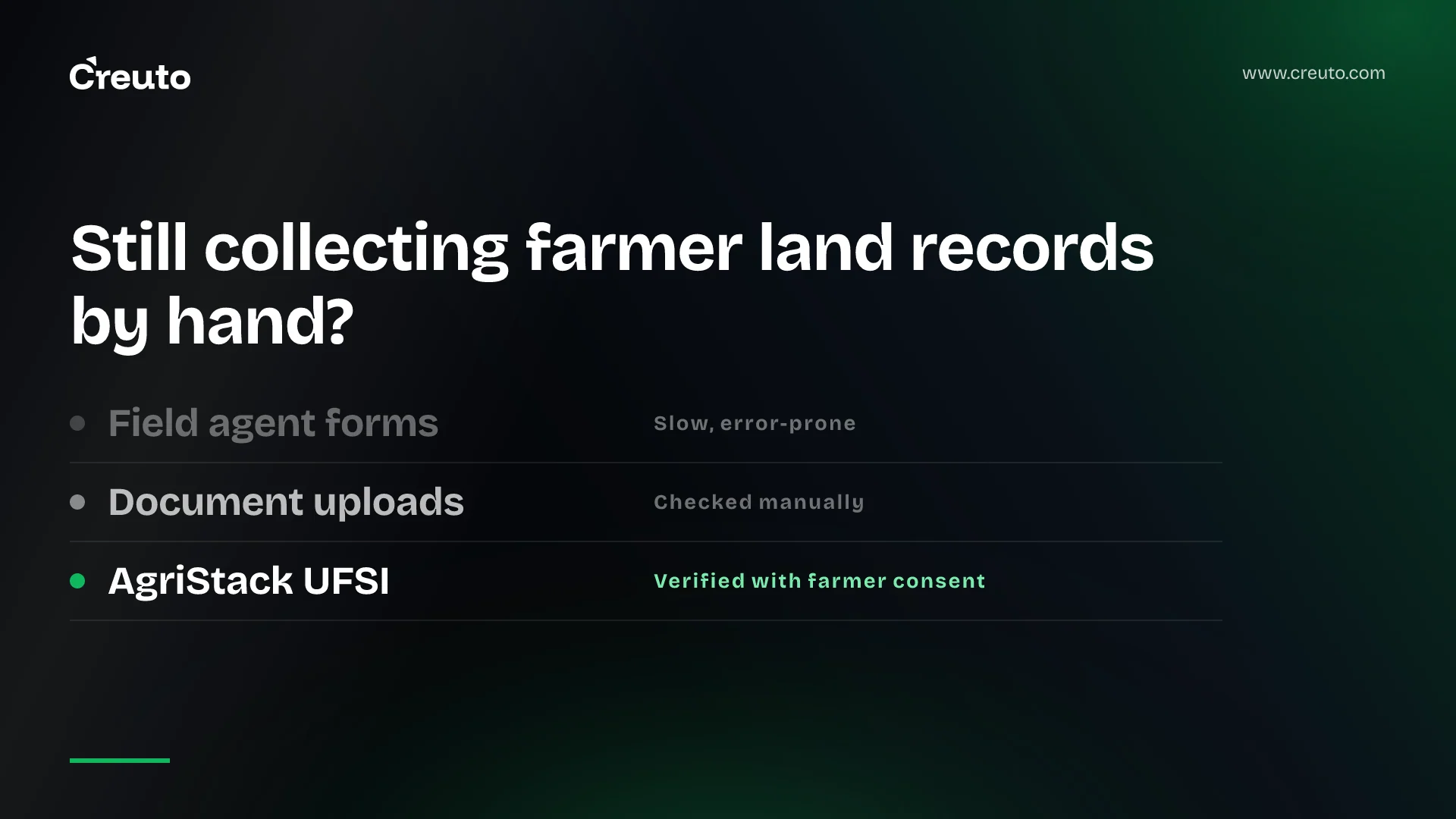
For most agritech products in India, knowing who a farmer is, where their land is and what they grow still means collecting it by hand — forms, field agents, photographs of land records. The AgriStack API layer is designed to change that. Through a government gateway called the Unified Farmer Service Interface, authorised companies can verify farmer, land and crop information against state registries, with the farmer's consent. For anyone building agri-lending, advisory, insurance or supply-chain software, it changes what the onboarding flow should look like.
What is AgriStack?
AgriStack is India's digital public infrastructure for agriculture, built under the Digital Agriculture Mission. The Union Cabinet approved the mission on 2 September 2024 with an outlay of ₹2,817 crore, including a central share of ₹1,940 crore.
AgriStack is built on three foundational registries, created and maintained by state and union territory governments:
- Farmer Registry — who the farmer is, with a digital farmer ID linked to their land records.
- Geo-referenced village maps — where the land is.
- Crop Sown Registry — what is grown, built from digital crop surveys.
The government set a target of digital identities for 11 crore farmers across FY 2024-25 to FY 2026-27. Coverage varies from state to state and changes quickly, so check the current position for the states you operate in rather than relying on a national figure.
What is the Unified Farmer Service Interface?
The Unified Farmer Service Interface (UFSI) is the layer through which service providers reach that data. The portal describes it as a framework for secure data sharing across platforms that respects each state's own systems, so that services such as credit, advisory and market access can integrate through APIs. Its public site lists the components a developer will deal with:
- Sandbox — a test environment giving developers and researchers access to AgriStack APIs with synthesised datasets.
- Network Manager — the module for API exchange between information providers and information users, covering API discovery, access workflows, role management and monitoring.
- Consent Manager — a portal where farmers authenticate through their state's system, manage consent through its lifecycle (pending, active, revoked, expired), and sign digitally with Aadhaar eSign.
- API specifications — standard schemas, request and response structures and error codes across UFSI APIs.
Can private companies use AgriStack data?
Yes, as authorised users and with consent — not by bulk access. UFSI is designed for banks, agritech companies and value-chain businesses to request specific farmer data for a specific service, with the farmer granting, and able to revoke, that consent. The practical implications for product teams:
- Consent is part of your user flow. A farmer approving a data request becomes a step in onboarding, and it can expire or be revoked. Your system must handle both.
- Verification replaces collection. Instead of uploading documents for manual checking, you verify identity, landholding and crop details against state registries.
- Your data model should hold references, not copies. Store the farmer ID, the consent reference and what was verified when, rather than duplicating registry data you may lose the right to keep.
- State variation is real. Registries are maintained by states, so coverage, data quality and timelines differ. Design for partial availability, with a fallback to manual verification.
How agritech apps integrate with the AgriStack API
A sensible sequence for a team starting now:
- Start in the sandbox. Build against synthesised data and the published specifications before seeking production access.
- Map your use case to the registries. A crop loan needs identity, land and crop data; an advisory app may need only crop and location. Ask for the minimum.
- Design the consent experience for farmers. Many will use it on a basic phone in their own language, often with a field agent's help. Test it with real users.
- Plan the authorisation route. Production access runs through the Network Manager's access workflows; allow time for approvals.
- Keep an audit trail. Record every request, consent and response, because lenders and insurers will need to prove what they checked and when.
What is a farmer ID in India?
A farmer ID is the digital identity issued through a state's Farmer Registry, linked to the farmer's land records. It lets a farmer prove who they are and what land they hold to any authorised service, rather than submitting the same documents again for each scheme, loan or insurance policy. For product teams, it is the key that ties your records to the registries.
Why this matters for agritech products
Onboarding cost and data quality are two of the hardest problems in agritech, and both come down to farmer and land data. We saw this when building the AquaPulse agritech platform for aquaculture, where reliable information about farms and farmers underpins everything from advisory to traceability. Export traceability rules, such as those we covered in shrimp export traceability software, raise the value of verified origin data further.
AgriStack will not remove the need for field work, and state-by-state variation means it will be uneven for some time. But a product designed today should assume consent-based registry verification as the default and manual collection as the fallback, not the other way round. Our custom software development team builds agritech platforms designed for exactly that, and our API integration practice can handle the UFSI connection itself.
Frequently asked questions
AgriStack is India's digital public infrastructure for agriculture under the Digital Agriculture Mission, approved in September 2024 with a ₹2,817 crore outlay. It rests on three state-maintained registries: the Farmer Registry, geo-referenced village maps and the Crop Sown Registry.
The Unified Farmer Service Interface, or UFSI, is AgriStack's API gateway for authorised service providers. It includes a sandbox with synthesised data, a network manager for API access workflows, a consent manager for farmers, and standard API specifications.
Private companies such as banks and agritech firms can use AgriStack data as authorised users through UFSI, with the farmer's consent for each request. Farmers can grant, revoke or let consent expire, so products must be designed around consent rather than bulk access.
A farmer ID in India is a digital identity issued through a state's Farmer Registry and linked to the farmer's land records. It lets farmers prove identity and landholding to authorised services without resubmitting documents for every scheme, loan or insurance policy.