AGI vs ASI: the difference that decides what you build
agi vs asi explained against real evaluations: what narrow AI, AGI and ASI each claim, dated ARC Prize scores, and which one you can actually buy today.
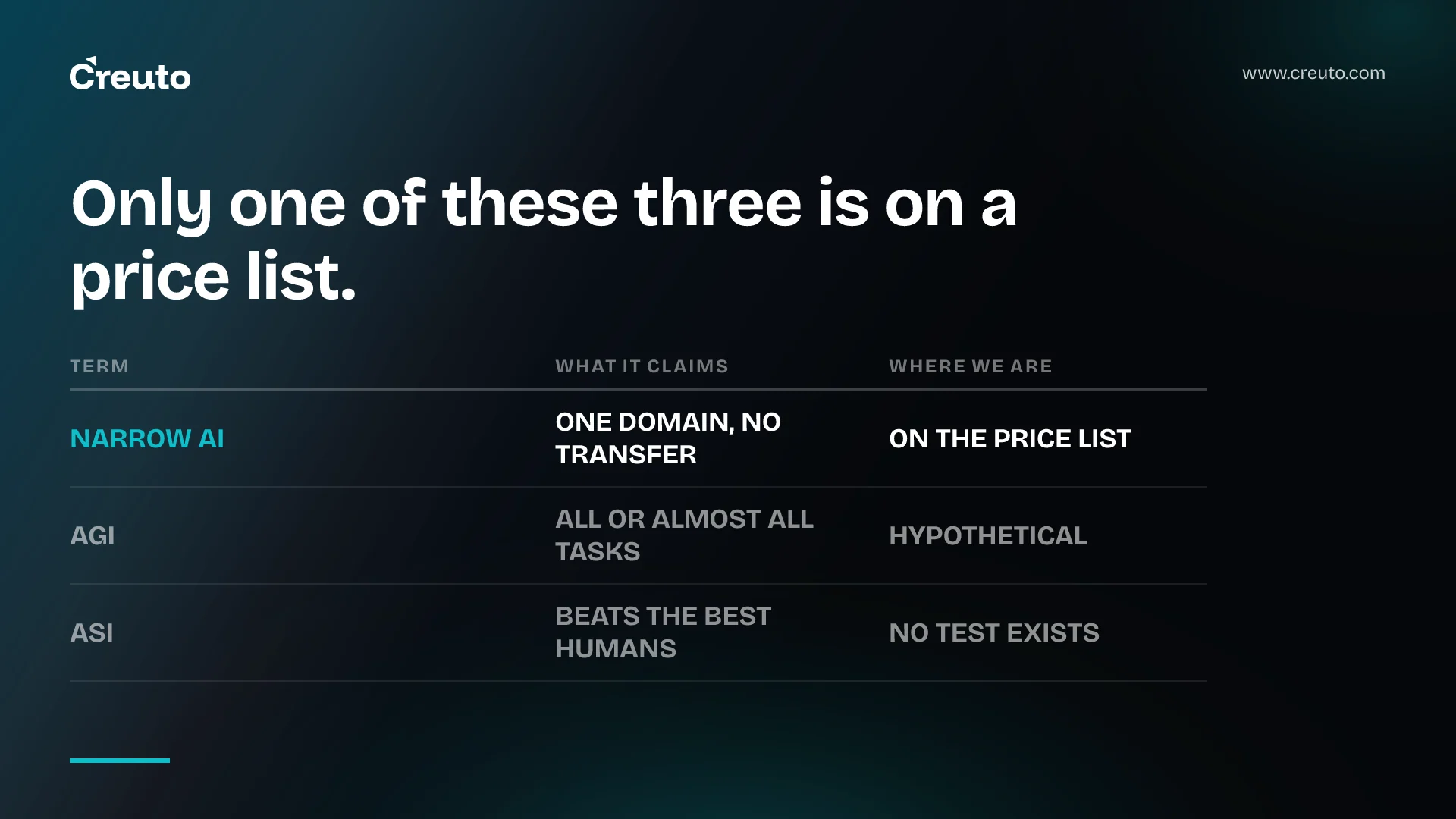
The practical difference in agi vs asi is that one of the three terms on the ladder is on a price list and two are not. Narrow AI you can buy this quarter. Artificial general intelligence is defined as hypothetical by the experts who assess the field. Artificial superintelligence has no test attached to it at all.
Vendors blur the three because the blur sells. This post defines each against how systems are actually evaluated, puts today's frontier models on dated public benchmark scores, and ends with the only question that matters when you are signing something: which of the three is a purchasing decision today.
AGI vs ASI vs narrow AI: three different claims
These are not three points on one dial. They are three claims of different kinds, and they fail in different ways.
| Term | What it claims | How you would test it |
|---|---|---|
| Narrow AI (ANI) | Strong performance in one domain, no transfer | Task-specific evaluation against your own data |
| AGI | Equals or surpasses human performance on all or almost all cognitive tasks | No accepted test; the assessment that defines it calls it hypothetical |
| ASI | Much smarter than the best human brains in practically every field | No test exists for it, because the definition ranges over every field |
The definitions are not ours. AGI is defined in the glossary of the International AI Safety Report 2026, chaired by Yoshua Bengio and guided by over 100 experts from more than 30 countries, as "a hypothetical AI model or system that equals or surpasses human performance on all or almost all cognitive tasks". ASI follows Nick Bostrom's 1998 definition: "an intellect that is much smarter than the best human brains in practically every field, including scientific creativity, general wisdom and social skills".
Read those two side by side and the difference is not degree, it is who you are being compared against. AGI is parity with humans across the board. ASI is decisive advantage over the best humans across the board. A system could clear the first and not the second by a wide margin.
What is narrow AI, and why it is the only one on the price list
Narrow AI is a system that performs well inside a bounded domain and does not carry that competence outside it. That bound is a feature, not an apology. It is what makes the thing testable, priceable and possible to put behind a service-level commitment.
Almost everything shipping in production is this, including work that uses a frontier model. A disease-prediction model over pond sensor data is narrow: our Aquapulse aquaculture platform runs pond monitoring, disease prediction and advisory for 6,000-plus registered farmers across 8,000-plus acres, and none of that requires a system with any general competence at all. The scope is the product.
The same holds for the classification and routing layers inside most AI features, where a narrow model frequently beats a general one on cost and determinism. That trade-off is the subject of when a decision model beats an LLM, and it is the version of this debate that actually reaches your invoice. Spend patterns bear it out: the split between open-weight and frontier models in LLM cost optimisation is a narrow-versus-general decision made thousands of times a day by people who are not thinking about AGI at all.
AGI is defined as hypothetical by the people who assess the field
The word "hypothetical" in that glossary entry is doing deliberate work. The report has a chapter on measured capabilities and a chapter on risks. AGI gets a glossary line. The rung above it gets nothing: the words "superintelligent" and "superhuman" appear in the report only inside bibliography entries, in the titles of papers it cites.
ARC Prize, which builds the best-known public test of general reasoning, defines the target differently and more usefully. It states that AGI is "a system that can match the learning efficiency of humans", and that what ARC-AGI measures is "skill-acquisition efficiency on unknown tasks". The criterion it applies is a comparison, not a score: "As long as there is a gap between AI and human learning, we do not have AGI."
Is GPT AGI? The strongest version of the yes case
State it properly, because it is not weak. Measured: the safety report records leading models scoring over 90% on undergraduate-level examinations in subjects from chemistry to law, over 80% on graduate-level science questions in GPQA, and gold-medal-level results at the International Mathematical Olympiad in July 2025, solving five of six problems under competition-like conditions. A system that does all of that is not narrow in any ordinary sense. It transfers across domains it was never specifically trained on.
The counter is in the same report, in the word it repeats: jagged. Its own assessment is that "leading systems may excel at some difficult tasks while failing at other, simpler ones", that they get derailed by simple errors during multi-step projects, still produce false statements, give inconsistent outputs on identical inputs, and cannot yet integrate with robotic components to perform basic physical tasks such as housework. "All or almost all cognitive tasks" is a claim about the floor of a capability profile. Jagged means the floor is the part nobody has raised.
So the honest answer to whether today's frontier models are AGI is: they are general in coverage and not general in reliability, and the definition is about reliability across coverage.
ASI is the claim with no test attached
Here the problem is not that the score is low. It is that there is no score. Nobody has proposed an evaluation that a system passes only if it exceeds the best humans in practically every field, and it is hard to see how one could exist, because the definition ranges over fields nobody has enumerated. Bostrom's definition also names general wisdom and social skills alongside scientific creativity, and neither has an accepted benchmark.
The report supplies the structural reason this will not be fixed by a better benchmark next quarter. It names an "evaluation gap": performance on pre-deployment tests "does not reliably predict real-world utility or risk". It adds that "there is no single, comprehensive, and continuously updated synthesis of AI capabilities", and that performance depends heavily on the specific test examples and prompt used, making it difficult to prove with high confidence that a system cannot do something.
That last clause is the one that kills ASI as a measurable threshold. You cannot certify universal superiority with a test suite that cannot even certify a single absence.
Meanwhile the word is being used commercially. Mark Zuckerberg wrote on 30 July 2025 that "Developing superintelligence is now in sight", setting out Meta's goal of personal superintelligence for everyone. That is a forecast in a corporate letter, not a measurement. Treat it as the former.
How close are we to AGI? What the leaderboards say, dated
Benchmark figures move weekly, so date them. These come from the official ARC Prize leaderboard, whose underlying data file was generated on 30 September 2026.
| Benchmark | Best system | Score | Cost per task | Human panel |
|---|---|---|---|---|
| ARC-AGI-1 (semi-private) | GPT-6.1 Sol (High) | 98.5% | about $0.06 | 98.0% at $17 |
| ARC-AGI-2 (semi-private) | GPT-6 Astra (Max) | 95.0% | about $1.12 | 100% at $17 |
Measured: on ARC-AGI-1 the leading systems now sit above the human panel, at roughly a three-hundredth of the cost per task. On ARC-AGI-2, which adds symbolic interpretation, compositional reasoning and context-dependent rule application, the best system is at 95.0% against a panel that solved everything. ARC Prize has already moved the goalposts on purpose with ARC-AGI-3, an interactive benchmark that scores how efficiently an agent explores novel environments and acquires goals over time rather than whether a final answer is right.
The single most transferable measurement is not an exam score at all. The report cites a study finding that AI systems complete well-specified software engineering tasks that take human experts 30 minutes around 80% of the time, and that this task length has been doubling roughly every seven months. Forecast, and the report labels it as one: several hours by 2027 and several days by 2030 if the trend holds. We do not assert a date for AGI or ASI, and neither does the report, which instead presents four OECD scenarios concluding that by 2030 progress "could plausibly range from stagnation to rapid improvement to levels that exceed human cognitive performance".
The business translation: which of the three is a purchasing decision today
Narrow AI is the purchasing decision. AGI is a research question you can read about. ASI is a research question you cannot currently even score.
The practical test for any vendor claim is to convert it back into narrow terms and see whether anything survives. Ask what task, how long that task takes a competent human, what the measured success rate is at that duration, on which benchmark, on which date, and what your product does on the runs that fail. In the AI engineering work we do, those five answers determine the architecture, and no answer about general intelligence changes any of them.
This is the wrong framing in one case worth naming. If your product's value comes from a capability that is currently jagged, such as long unattended multi-step execution with money attached, then neither buying narrow AI nor waiting for AGI is the answer. The answer is to redesign the task so a measured 30-minute reliability window is enough, which is usually possible and almost always cheaper than the alternative. That is the conversation to have before anyone budgets for generative AI on the assumption that the next model release closes the gap.
Your next decision is not where AGI sits on a timeline. It is which single narrow task in your workflow you can define tightly enough to measure by the end of the month.
Frequently asked questions
AGI is a system that equals or surpasses human performance on all or almost all cognitive tasks, which is parity with people across the board. ASI, artificial superintelligence, is much smarter than the best human brains in practically every field. The difference is who the comparison is against: people in general, or the best experts alive.
Narrow AI is a system that performs well inside a bounded domain and does not carry that competence outside it. A pond disease-prediction model is narrow AI. The bound is what makes narrow AI testable against your own data, priceable, and possible to put behind a service-level commitment.
Nobody can answer that from evidence. On the ARC Prize leaderboard data generated on 30 September 2026, the best ARC-AGI-2 score was 95.0% against a human panel at 100%, while the International AI Safety Report 2026 still defines AGI as hypothetical and calls current capabilities jagged.
Frontier GPT-class models are general in coverage and not general in reliability. They score over 90% on undergraduate examinations and reached gold-medal level at the 2025 International Mathematical Olympiad, yet get derailed by simple errors in multi-step projects. AGI is a claim about reliability across coverage.
Artificial superintelligence is the rung named after AGI: an intellect much smarter than the best human brains in practically every field. Unlike AGI, it has no proposed evaluation at all, because its definition ranges over fields nobody has enumerated, including general wisdom and social skills.
Only narrow AI is a purchasing decision today. AGI and ASI are research questions, and ASI is one with no test attached. A vendor claim is worth converting into narrow terms: which task, how long it takes a human, the measured success rate, the benchmark, and the date.
Frontier benchmark scores move within weeks, so an undated figure is unusable. The ARC-AGI-2 figures in this post come from the official ARC Prize leaderboard data file generated on 30 September 2026, and the International AI Safety Report 2026 warns separately that benchmarks poorly predict real-world performance.